
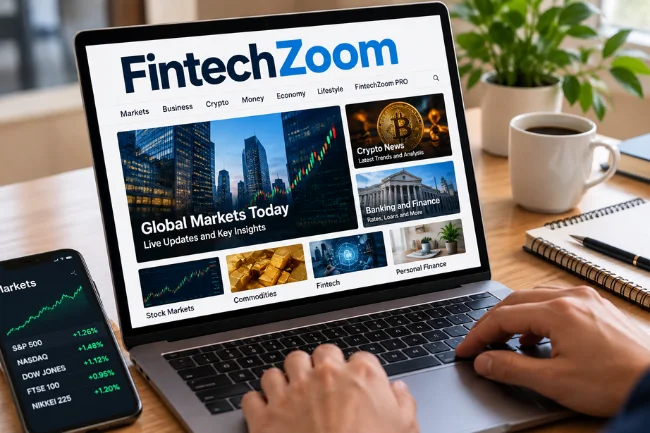
Financial markets can feel overwhelming when prices, economic reports, company announcements, interest rates, currencies, commodities, and global events are moving at the same time. For readers who want a convenient way to follow these developments, fintechzoom.com markets provides a broad view of financial activity across different asset classes and regions. The platform brings market information and financial explanations together, helping readers understand not only what is happening but also the factors that may be influencing market behavior.
The appeal of fintechzoom.com markets comes from its broad approach to financial coverage. Instead of treating stocks, currencies, commodities, bonds, and other instruments as completely separate subjects, market coverage can be understood as part of a connected financial system. A change in interest-rate expectations, for example, can affect bonds, currencies, equities, and commodities at the same time. Understanding these relationships can make financial news considerably easier to follow.
What Is FintechZoom.com Markets?
Fintechzoom.com markets refers to the markets-focused area of FintechZoom, a financial media platform covering subjects such as stocks, global indices, forex, commodities, bonds, exchange-traded funds, cryptocurrency, banking, and broader economic developments. The markets section is designed to give readers a wider perspective rather than concentrating exclusively on one type of investment.
This broad coverage matters because modern financial markets are highly interconnected. Investors following an equity index may also need to understand bond yields, currency movements, energy prices, or central-bank expectations. The fintechzoom.com markets approach brings these subjects into a common financial context, allowing readers to move between market categories while building a more complete picture of current conditions.
Why FintechZoom.com Markets Attracts Financial Readers
One reason people explore fintechzoom.com markets is convenience. Financial information is available from countless sources, but constantly moving between different websites can make research unnecessarily complicated. A broad financial platform can provide a starting point where readers can review market developments and then explore individual subjects in greater depth.
Another useful characteristic is the combination of market coverage and educational material. A reader who sees an unfamiliar financial term does not necessarily need a professional trading background to understand it. Explainers can provide context around indices, stocks, commodities, forex, bonds, and other financial instruments. This makes fintechzoom.com markets relevant to both people developing their financial knowledge and experienced readers looking for a quick overview of market activity.
Stock Market Coverage on FintechZoom
Stocks remain one of the most closely followed areas of financial markets. Companies listed on major exchanges can react to earnings reports, economic conditions, industry developments, interest rates, investor sentiment, and unexpected news. Because of this, simply looking at a stock price rarely explains the complete story behind a market move.
Within the wider fintechzoom.com markets environment, stock-market information can be considered alongside broader market indicators. This helps readers think beyond individual companies and consider sectors, indices, regional markets, and macroeconomic conditions. Such context is particularly useful when a stock moves sharply while the broader market behaves differently.
A stock can rise even when the overall market is weak, or fall even while major indices are advancing. Company-specific developments, valuation expectations, earnings guidance, and industry conditions can all create differences between individual securities and the broader market.
Understanding Global Indices
Market indices provide a useful way to observe groups of securities without examining every company individually. Major American, European, and Asian benchmarks can offer a snapshot of regional market sentiment, although each index has its own methodology and composition.
The fintechzoom.com markets coverage of global indices can therefore be useful for readers who want to understand how different regions are performing. An American index may respond strongly to technology companies and domestic economic expectations, while a European benchmark can have substantial exposure to financial institutions, industrial businesses, energy companies, or other sectors. Asian indices can similarly reflect their own economic structures and market conditions.
It is important to remember that an index is not the same thing as an entire economy. Index composition, weighting methods, currency movements, and sector exposure all influence its behavior. Looking at these characteristics can provide more useful information than simply observing whether an index has moved higher or lower.
Forex and Currency Markets
Foreign exchange is another important part of global financial markets. Currencies influence international trade, tourism, investment flows, corporate revenues, imported goods, and the cost of commodities. Because currencies are traded in pairs, their movements are always relative to another currency.
Fintechzoom.com markets can be useful for readers exploring forex because currency movements often connect directly with broader economic developments. Interest-rate expectations, inflation, employment conditions, central-bank decisions, geopolitical developments, and investor demand for different assets can all influence currency markets.
Currency markets also operate differently from traditional stock markets. They are highly international, and major financial centers participate across different regional trading sessions. This means developments in one part of the world can influence currency prices elsewhere as financial activity moves between markets.
Commodities and Their Influence
Commodities occupy an important position in the financial system because they represent physical resources used throughout the global economy. Energy products, precious metals, industrial materials, and agricultural goods can all experience substantial price changes based on supply, demand, weather, geopolitical events, production decisions, and economic growth.
The fintechzoom.com markets framework treats commodities as part of the broader market environment rather than as an isolated investment category. This is valuable because commodity movements can affect businesses and consumers. Higher energy prices, for example, can influence transportation expenses, manufacturing costs, inflation expectations, and household spending.
Gold also attracts considerable attention because investors often view it differently from industrial commodities. Its behavior can be influenced by inflation expectations, real interest rates, currency movements, central-bank activity, and demand for assets perceived as defensive. Understanding these relationships makes commodity coverage more meaningful than simply watching a daily price change.
Bonds and Interest Rates Matter
Bonds sometimes receive less attention from casual market observers than stocks, but they are central to the financial system. Government and corporate borrowing costs can influence businesses, consumers, banks, investors, and governments.
Interest rates are particularly important because they affect the cost of borrowing and the attractiveness of different investments. When expectations around monetary policy change, bond yields can move, and those movements may influence equity valuations and currency markets as well.
The fintechzoom.com markets approach is useful here because bonds and rates can be considered alongside stocks and other financial assets. Instead of viewing an equity-market movement in isolation, readers can ask whether changes in bond yields, monetary-policy expectations, or economic forecasts may be contributing to the move. FintechZoom itself presents dedicated market material covering bonds, rates, forex, commodities, and global indices.
Exchange-Traded Funds and Market Exposure
Exchange-traded funds have become an important tool for investors seeking exposure to collections of securities or specific market themes. An ETF can provide access to an index, industry, geographic region, commodity, bond market, or other strategy through a single listed instrument.
For readers using fintechzoom.com markets as a research starting point, ETF coverage can help connect broad market themes with investable instruments. Rather than researching every company in a particular sector, a reader may first examine the performance and composition of an appropriate fund.
However, an ETF is not automatically low risk simply because it contains multiple securities. Its risk depends on what it owns, how concentrated its holdings are, how the underlying market behaves, and how the fund is structured. Understanding the underlying exposure remains important before making any investment decision.
How Economic News Moves Financial Markets
Financial markets respond to economic information because investors are constantly adjusting expectations about future conditions. Inflation, employment, economic growth, interest rates, consumer spending, manufacturing activity, and government policy can all affect expectations.
One important concept is that markets often respond to the difference between expectations and actual results. A piece of economic data can appear positive in isolation but still cause markets to fall if investors expected an even stronger result. Conversely, apparently weak information can sometimes support prices if the outcome is better than investors feared.
This is one reason fintechzoom.com markets can be more useful when readers focus on context rather than headlines alone. A headline explains what happened, but financial analysis should also consider why it happened, what investors expected beforehand, and which other markets are reacting at the same time.
The Connection Between Markets
Financial markets do not operate inside separate boxes. Stocks, bonds, currencies, commodities, and digital assets can influence one another through capital flows, expectations, liquidity, and economic relationships.
For example, a significant change in energy prices can affect inflation expectations. Inflation expectations can influence monetary-policy expectations. Changes in monetary policy can influence bond yields and currencies. Those movements can then affect company valuations and investor sentiment. The chain can continue across different markets.
This interconnected structure explains why fintechzoom.com markets covers several financial categories instead of focusing exclusively on stock prices. The broader the market perspective, the easier it becomes to recognize relationships that may otherwise appear unrelated.
Using FintechZoom.com Markets for Market Research
The most effective way to use fintechzoom.com markets is as part of a structured research routine rather than as a source of automatic trading decisions. Start by identifying the broad market environment, then move toward the specific asset or company that interests you.
A useful research process can include reviewing major market developments, checking relevant economic news, examining the asset’s historical behavior, understanding its fundamental drivers, and considering the risks involved. Readers should also distinguish between factual reporting, analysis, commentary, and promotional material.
The platform can provide information and context, but investors should not assume that every market article represents a recommendation. Financial markets are uncertain by nature, and no article can eliminate the possibility of losses.
What Beginners Should Watch For
New investors often make the mistake of focusing entirely on price movements. A rising price can look attractive, while a falling price can appear alarming, but neither movement automatically explains what may happen next.
Beginners using fintechzoom.com markets should instead develop the habit of asking basic questions. What asset am I looking at? What causes its price to move? Which economic factors matter most? Is the current movement connected to company-specific news or broader market conditions? What risks could invalidate the current market narrative?
These questions encourage independent thinking. They also reduce the temptation to react emotionally to every headline or short-term price movement.
The Importance of Risk Management
Market research is only one part of responsible investing. Risk management is equally important because even well-researched investments can move unexpectedly. Economic conditions can change, companies can disappoint, geopolitical developments can create volatility, and market sentiment can shift quickly.
Readers exploring fintechzoom.com markets should therefore consider diversification, position sizing, time horizon, liquidity needs, and personal tolerance for losses. A strong research process should not only ask how an investment might perform under favorable conditions but also what could go wrong.
It is also useful to separate money needed for short-term expenses from money intended for long-term investing. This can reduce the pressure to sell investments unexpectedly during periods of market weakness.
FintechZoom.com Markets and Global Market Awareness
A major benefit of following international financial coverage is that it encourages readers to think beyond a single country. The global economy is connected through trade, capital flows, supply chains, currencies, energy markets, and financial institutions.
Fintechzoom.com markets reflects this broader perspective by covering financial developments across different regions and asset classes. FintechZoom’s current markets material includes global indices alongside dedicated coverage of areas such as stocks, forex, commodities, bonds, and digital assets.
This global approach can be especially useful for investors whose portfolios contain international securities or funds. Even investors focused primarily on one domestic market can benefit from understanding what is happening elsewhere because overseas developments can affect domestic sentiment and capital flows.
How to Read Market Headlines More Carefully
Financial headlines are designed to attract attention, but readers should avoid treating a headline as a complete investment thesis. A market headline may describe a price movement without explaining its broader implications or the uncertainty surrounding it.
When reading fintechzoom.com markets, it is helpful to look for the underlying explanation. Was the movement caused by economic data, company news, interest-rate expectations, commodity prices, currency movements, or a change in investor sentiment? Does the article describe a confirmed event or an interpretation of what might happen?
This distinction becomes particularly important during periods of high volatility. Markets can move quickly, and early explanations may later change as additional information becomes available. Good financial research leaves room for uncertainty rather than presenting every market move as predictable.
The Role of Technology in Modern Financial Research
Technology has transformed the way people interact with financial information. Investors no longer need to depend exclusively on printed newspapers or traditional financial terminals to follow market developments. Online platforms can provide market news, educational resources, charts, financial explanations, and updates from around the world.
The broader FintechZoom platform combines financial news with market-oriented information and educational content across areas including stocks, markets, cryptocurrency, banking, and financial technology.
For readers, the advantage is speed and accessibility. The challenge is information overload. More data does not automatically produce better decisions. The real skill is identifying relevant information, checking its context, and separating meaningful developments from short-term noise.
Is FintechZoom.com Markets Useful for Investors?
The usefulness of fintechzoom.com markets depends on how the information is used. As a financial information resource, it can help readers discover market developments, understand different asset classes, and explore explanations of financial concepts.
It should not, however, be treated as a substitute for personal research, professional financial advice, or careful consideration of individual circumstances. Market information can support decision-making, but it cannot predict every future price movement.
The strongest use of a financial platform is often educational. By consistently studying market relationships, economic indicators, company developments, and investment risks, readers can gradually build a more informed understanding of financial markets.
Final Thoughts on FintechZoom.com Markets
Financial markets can appear complicated because many forces operate simultaneously. Stocks react to earnings and expectations, currencies respond to economic and monetary conditions, commodities reflect supply and demand, and bonds provide important signals about interest-rate expectations. Looking at these markets together creates a more complete financial picture.
Fintechzoom.com markets provides a broad environment for exploring these subjects and following developments across different financial categories. Its coverage includes equities, global indices, forex, commodities, bonds, ETFs, and digital assets, giving readers a convenient starting point for understanding the wider market landscape.
The key is to use financial information thoughtfully. Rather than chasing every market headline, readers can focus on understanding the forces behind price movements, comparing information from reliable sources, considering uncertainty, and maintaining sensible risk-management practices. That approach turns market coverage from a stream of distracting headlines into a useful tool for building financial knowledge.
About the Author